|
|
ON ELECTION DAY, CATHOLICS VOTE COMMON GOOD HIGHLIGHTS NATIONAL OUTREACH AS PEW DOCUMENTS DECLINING CATHOLIC APPROVAL OF TRUMP
Research also finds broad favorable views of Pope Leo XIV |
|
|
WASHINGTON, DC — Catholics Vote Common Good highlighted its extensive voter outreach and education efforts alongside Pew Research Center findings documenting declining approval of President Donald Trump among U.S. Catholics and widespread favorable views of Pope Leo XIV.
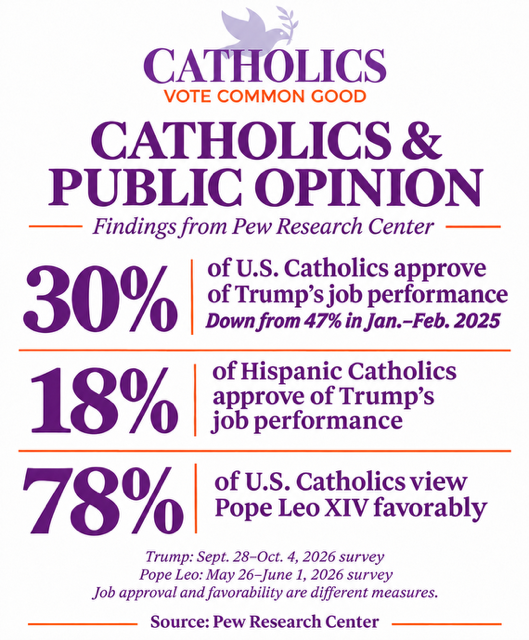
Pew’s September 28–October 4, 2026 survey found that Trump’s job approval among U.S. Catholics stood at 30%, down from 47% in January–February 2025, a decline of 17 percentage points. Among Hispanic Catholics, his approval stood at 18%. Hispanic Catholic registered voters favored Democratic House candidates over Republican candidates by 59% to 19%. www.pewresearch.org
“These findings deserve serious attention in the national conversation about faith and public life,” said Denise Murphy McGraw, national co-chair of Catholics Vote Common Good. “They show clearly that Catholics feel betrayed by Trump and newly minted Catholic JD Vance. Our organization has worked extensively to bring Catholic social teaching into public discussion and help people examine the relationship between political promises, government policies and their consequences for families and communities.”
Catholics Vote Common Good work has included national organizing conversations, post carding, mobil billboards, voter education, volunteer outreach, public communications and its first national candidate endorsement effort. The organization has also challenged the use of religious identity in campaign messaging and raised questions about whether public officials’ actions reflect their stated commitments to human dignity and the common good.
In a separate survey conducted May 26–June 1, 2026, Pew found that 78% of U.S. Catholics viewed Pope Leo XIV favorably. That survey also found that 51% of Catholics believed Trump had been too critical of the pope. www.pewresearch.org
“Pope Leo’s welcoming and uplifting leadership has been an important focus of our public education work,” McGraw said. “We are proud to have created opportunities for people to discuss compassion, solidarity and service, and to consider what those principles mean in public life.”
The surveys measure different attitudes at different points in time: presidential job approval and papal favorability. They do not assess the effect of CVCG’s outreach or attribute changes in public opinion to any individual organization. |
|
About Catholics Vote Common Good |
|
Catholics Vote Common Good is a national progressive faith organization that brings Catholics from throughout the country together to put faith into action in public life. Grounded in Catholic social teaching, the organization engages Catholics in civic life and works to advance human dignity, justice, compassion and solidarity. |
|
|
|
Thank you |
|
|

|
© 2026 Catholics Vote Common Good https://www.votecommongood.com/catholics-vote-common-good/ Our mailing address is: 1177 Rosehill Blvd Schenectady, NY 12309-4626 USA |
|
You are receiving this email because you opted in on our website or at an event, if you feel you have gotten this email in error we would hate to see you go but you can change your subscription status by clicking the link below to update your preferences. |